

On this page 13 sections
- Birth Certificate at a Glance
- What Is a Birth Certificate?
- Who Issues the Birth Certificate: Union Council or NADRA?
- Birth Certificate Fee by Province
- How to Apply for a Birth Certificate in Pakistan
- Documents Required for a Birth Certificate
- The 60-Day Rule and Late Registration
- Can You Apply for a Birth Certificate Online?
- What Comes Next: The B-Form
- Using a Birth Certificate Abroad
- What If There Is a Mistake in the Birth Certificate?
- Mistakes to Avoid
- Frequently Asked Questions
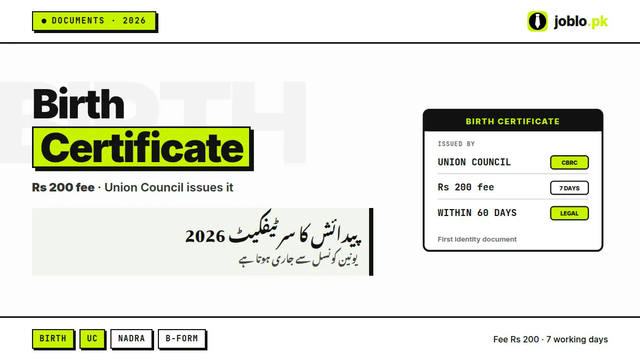
A birth certificate in Pakistan is issued by your local Union Council, not by NADRA. You register the birth at the Union Council where the child was born, submit the hospital slip and both parents’ CNICs, and the certificate is issued in about 7 working days. The standard fee is about Rs 200, and in Punjab registration is free up to 7 years of age.
The birth certificate is the first official proof of identity. Without it, your child cannot get a B-Form, a passport, or school admission. Register within 60 days of the birth. After 60 days the process gets harder, and after 7 years it may need court approval.
Birth Certificate at a Glance#
| What | Detail |
|---|---|
| Issued by | Union Council, Municipal Committee or Cantonment Board |
| Standard fee | About Rs 200 (Punjab free up to 7 years of age) |
| Processing time | About 7 working days |
| Deadline | Register within 60 days of the birth |
| Documents | Hospital birth slip, both parents’ CNICs, Nikah Nama if requested |
| Next step | B-Form (Child Registration Certificate) from NADRA |
What Is a Birth Certificate?#
A birth certificate is an official document that records a child’s birth details: the name, the date of birth, the place of birth and the parents’ information. It is the foundation of a person’s legal identity.
You need it for the B-Form (Child Registration Certificate), a passport or visa, school admission, legal identity verification, and inheritance and property matters. Errors at this stage affect the B-Form, delay CNIC issuance and cause passport issues later. Check every spelling and date before you sign the proof print.
Who Issues the Birth Certificate: Union Council or NADRA?#
This is the most common confusion. NADRA does not issue birth certificates. Birth registration is handled by local government bodies. NADRA’s role comes afterward.
| Authority | What it issues |
|---|---|
| Union Council | Birth certificate (Computerized Birth Registration Certificate, CBRC) |
| Municipal Committee | Birth certificate, where the birth took place in its area |
| Cantonment Board | Birth certificate, for births in cantonment areas |
| NADRA | Child Registration Certificate (CRC), known as the B-Form |
The Union Council certificate is what NADRA uses to generate the B-Form. In Karachi, registration is handled through the relevant Union Committee. Most Union Councils have now moved to an online system. The certificate is generated only after approval is confirmed through NADRA’s central database, but the certificate itself is a local government document, not a NADRA one.
Birth Certificate Fee by Province#
The fee depends on where you register. Punjab waives it entirely for early registration. Other provinces and Islamabad charge by age and speed. Always confirm the current fee at your local office before paying, and ask for an official receipt.
| Region | Fee | Notes |
|---|---|---|
| Punjab | Free | No charge for registration and certificate issuance up to 7 years of age, under the Punjab Birth and Death Registration Rules |
| Islamabad (ICT) | Rs 200 to Rs 1,500 | Fee scales with the child’s age and processing speed, via the ICT Administration Citizen Facilitation Center |
| Other provinces | Rs 200 | Standard fee for registration within 60 days; late registration can range from Rs 500 to Rs 2,000+ |
| Khyber Pakhtunkhwa | Rs 500 | Fee for a corrected or reprinted certificate, separate from the original registration fee |

How to Apply for a Birth Certificate in Pakistan#
The process is straightforward but must be done correctly. One parent, or a close relative, must visit the Union Council in person. Before you go, check that both parents’ marital status is updated as “Married” in NADRA’s records. If it is not updated for either parent, the application may not be processed.
- Visit the Union Council covering the area where the child was born. Go to the Union Council, Municipal Committee or Cantonment Board office for that area.
- Submit the birth registration form with the required documents. The form is available at the office itself.
- Pay the fee at the counter. Ask for an official receipt.
- Wait for verification. Officials verify the submitted details against the parents’ records.
- Check the proof print carefully. The Union Council issues a proof print of the application for review. Check the name, the date of birth and every spelling.
- Sign the proof print and return it.
- Collect the certificate. The Union Council issues the Computerized Birth Registration Certificate (CBRC). It usually takes about 7 working days after submission and verification.

Documents Required for a Birth Certificate#
Bring originals. All details must match official records to avoid delays. Most delays are caused by incorrect data.
| Document | Notes |
|---|---|
| Hospital birth notification slip | Issued by the hospital where the child was born |
| Vaccination (immunization) card | Accepted instead of the hospital slip in many cases |
| CNIC of both parents | Originals; a close relative’s CNIC may be used if a parent cannot be present |
| Nikah Nama (marriage certificate) | If requested; both parents’ marital status must be “Married” in NADRA’s records |
| Affidavit | Signed and attested, confirming the birth, if the child was born at home |
| Birth registration form | Completed form from the relevant Union Council |
Our documents checklist explains the documents government jobs ask for, including the birth certificate. Our domicile guide explains the next identity document most families need. If you need an affidavit for a home birth, our affidavit guide explains the format and stamp paper.
The 60-Day Rule and Late Registration#
Registering a birth within 60 days is legally required in Pakistan. The longer you wait, the more documentation is needed to prove the child’s details.
| When you register | What happens |
|---|---|
| Within 60 days | Normal process applies |
| After 60 days | Additional verification is required |
| After 7 years | Court approval may be required |
In Punjab, late registration beyond 7 years of age may also require a newspaper advertisement and applicable administrative fees. Register early. A delayed registration tends to compound: the longer it is left, the more documentation is typically required.
Can You Apply for a Birth Certificate Online?#
Online registration is available in some cities through local government digitization initiatives. Not all districts support it. Many cases still require a physical visit to the Union Council for submission and verification. Check with your local Union Council before you go.
NADRA has started fully digital, end-to-end birth registration in six cities in Sindh through the Pak ID app. Residents there can complete the whole process, including home delivery of the certificate, without visiting a Union Council. NADRA plans to expand this system nationwide. Check the Pak ID app to see if your city is covered.
What Comes Next: The B-Form#
Once the Union Council certificate is issued, apply for the NADRA Child Registration Certificate (CRC), known as the B-Form. You can apply through the Pak ID app or at a NADRA centre. The fee is Rs 50 for normal processing (7 days) or Rs 500 for executive processing (1 day).
Parents must apply for the B-Form within 30 days of the birth under the NADRA Ordinance 2000. The B-Form is what your child needs for school admission, a passport and eventually their own CNIC at age 18. Without a birth certificate, no B-Form can be issued. Apply for the B-Form on nadra.gov.pk or through the Pak ID app.
Using a Birth Certificate Abroad#
A birth certificate is required for visa applications, immigration and embassy verification. For use abroad, it must first be verified by the issuing authority. It may then require attestation from the Ministry of Foreign Affairs, and embassy verification may also be needed.
Our MOFA attestation guide explains the attestation process, the fee and the offices. Get the certificate verified and attested before you submit it to an embassy. An unattested certificate is often rejected.
What If There Is a Mistake in the Birth Certificate?#
Errors like an incorrect name or a wrong date of birth must be corrected through the issuing authority. You will usually need an affidavit or supporting documents. The correction is made at the same Union Council that issued the certificate. In Khyber Pakhtunkhwa, a corrected or reprinted certificate costs Rs 500.
This is why the proof print matters. Check the name, the date of birth and every spelling on the proof print before you sign it. A mistake caught at the proof print stage costs nothing. A mistake found later costs a correction fee and weeks of delay.
Mistakes to Avoid#
- Waiting past 60 days. Registration within 60 days is legally required. After that, verification gets harder.
- Going to NADRA first. NADRA does not issue birth certificates. Start at the Union Council.
- Signing the proof print without checking it. Check the name, the date of birth and every spelling first.
- Forgetting the Nikah Nama. Both parents’ marital status must be “Married” in NADRA’s records, or the application may not be processed.
- Paying without a receipt. Ask for an official receipt at the counter.
Frequently Asked Questions#
How do I get a birth certificate in Pakistan?
Visit the Union Council, Municipal Committee or Cantonment Board office covering the area where the child was born. Submit the birth registration form with the hospital birth slip and both parents’ CNICs, pay the fee, check and sign the proof print, and collect the certificate in about 7 working days.
How do I apply for a birth certificate online?
Online registration is available in some cities through local government digitization initiatives, and NADRA offers fully digital registration in six Sindh cities through the Pak ID app. Not all districts support it, so check with your local Union Council first. Many cases still require a physical visit for submission and verification.
What is the fee for a birth certificate in Pakistan?
The standard fee is about Rs 200. In Punjab, registration and the certificate are free up to 7 years of age under the Punjab Birth and Death Registration Rules. Islamabad charges Rs 200 to Rs 1,500 depending on the child’s age and processing speed. Late registration can cost Rs 500 to Rs 2,000 or more. Always confirm the fee at your local office and ask for an official receipt.
Does NADRA issue birth certificates?
No. Birth certificates are issued by local Union Councils, Municipal Committees or Cantonment Boards, not by NADRA. NADRA uses the Union Council certificate to generate the B-Form (Child Registration Certificate) afterward. You can apply for the B-Form on nadra.gov.pk or through the Pak ID app.
What if the birth was not registered on time?
Late registration is possible. After 60 days, additional verification is required. After 7 years, court approval may be required, and in Punjab a newspaper advertisement may also be needed. Register as soon as you can: the longer you wait, the more documentation is typically required.


